How to Write a First Chapter Readers Can't Put Down
By team_desibuks · 20 Aug 2026 · 26 views
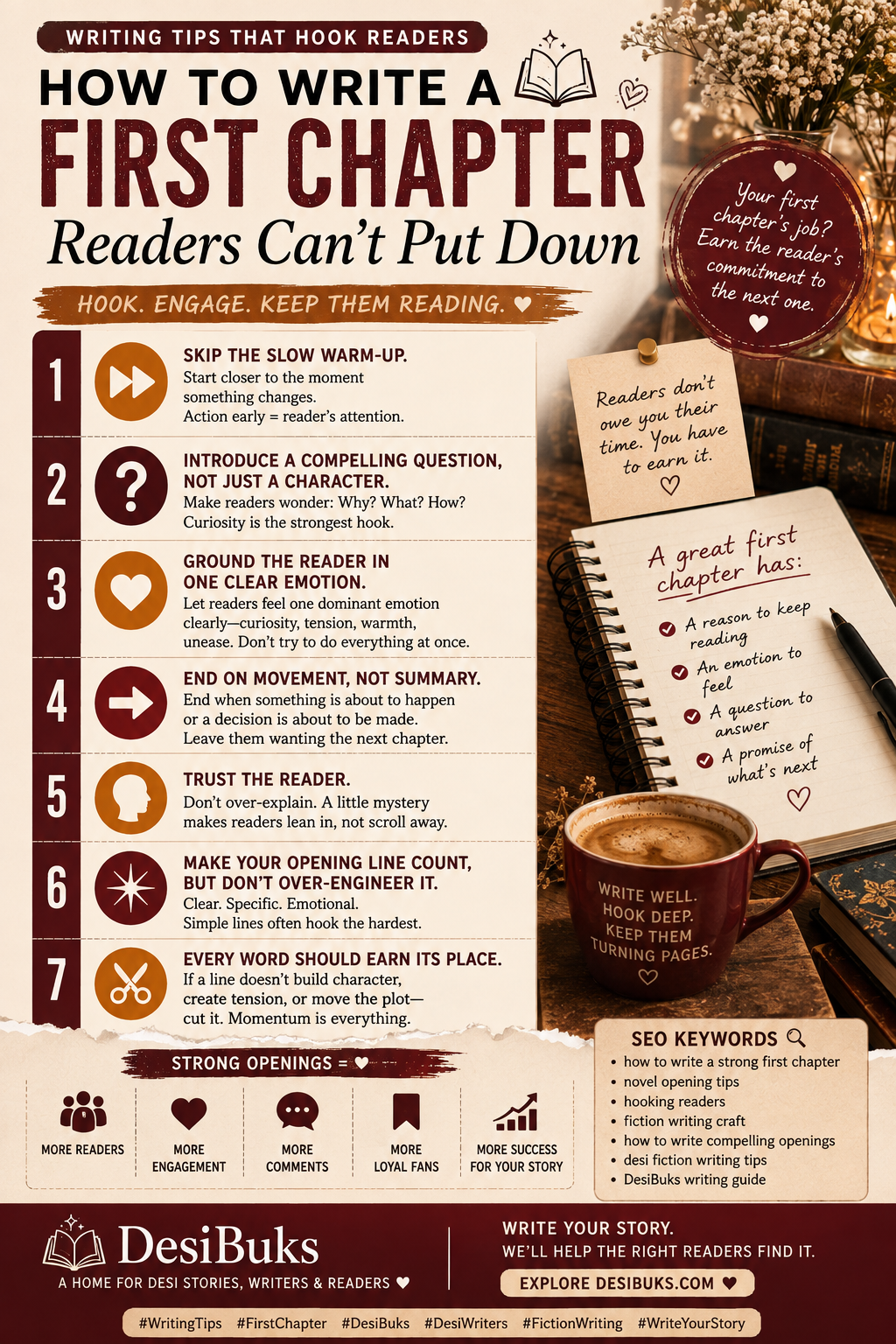
A reader opens your story with absolutely no obligation to finish it, no matter how much time or emotion you've personally invested in writing it. No one owes your book their attention — you have to earn it, deliberately, one chapter at a time, starting with the very first one they encounter.
The genuinely good news is that earning this trust doesn't require gimmicks, artificial cliffhangers, or manipulation of any kind. It requires clarity, real tension, and a genuine reason for the reader to care about what happens next. Here's how to build all three deliberately into your opening chapter, without relying on tricks that tend to feel hollow once readers notice them.
Skip the slow warm-up, even if it feels natural to include. Many first drafts spend a page or two carefully setting a scene, introducing a physical setting, or establishing a character's ordinary daily routine before anything of genuine consequence actually happens on the page. Readers are genuinely patient for good writing, atmosphere, and distinctive voice — but they're considerably less patient for extended stretches of prose where nothing is actually meaningfully at stake for anyone involved. Seriously consider starting your story closer to the moment something meaningfully changes for your protagonist, even if that means significantly restructuring what you'd originally imagined as your natural opening scene.
Introduce a compelling question, not merely a character. The most effective, memorable openings make a reader genuinely wonder something quite specific — why is she leaving without saying goodbye to anyone at all? What exactly is he hiding inside that unopened letter he keeps carrying everywhere with him? Why does everyone gathered at this particular table seem to be carefully avoiding one specific subject? A well-placed, specific question creates a kind of narrative gravity that pulls readers steadily forward, because human curiosity is a remarkably reliable motivator — often, in practice, considerably more reliable than dramatic action alone, however exciting that action might be on the surface.
Ground the reader in one clear, dominant emotion, rather than several competing ones. You don't need to explain your entire fictional world, every character's complete backstory, or the full scope of your intended plot within the first chapter alone. What you genuinely need is for the reader to feel something specific and clearly identifiable — curiosity, tension, warmth, unease, longing — clearly enough that they actively, consciously want more of that particular feeling by the chapter's end. Trying to establish too many separate emotional threads at once in a single first chapter often ends up diluting all of them simultaneously, leaving readers with a vague, unfocused sense of the story rather than a strong, specific, magnetic pull toward continuing.
End on movement, not on summary or neat resolution. Instead of closing your first chapter by neatly wrapping up the scene or carefully explaining what it all meant for the reader's benefit, try ending instead at a point where something is clearly about to happen, or a genuine decision is clearly about to be made by someone. Let the reader carry that specific, unresolved anticipation directly into the next chapter with them, rather than handing them a comfortable, natural stopping point where simply closing the app or setting down the book feels easy and entirely consequence-free.
Trust the reader considerably more than instinct might suggest you should. A common instinct among newer writers, understandable but often counterproductive, is to over-explain everything — clarifying every character's precise motivation, every relevant piece of backstory, every emotional beat in careful detail, out of a genuine but misplaced fear that readers won't otherwise understand what's happening. In reality, a little carefully held mystery, deployed deliberately and with real intention, is often exactly what makes someone click "next chapter" rather than simply closing the tab and moving on to something else. Readers generally, genuinely enjoy the specific experience of gradually piecing a story together themselves; robbing them of that particular experience by over-explaining everything upfront can make even an otherwise strong, well-written story feel curiously flat and over-managed.
Make your opening line genuinely count, without over-engineering it into something forced. There's considerable pressure, sometimes entirely self-imposed by the writer, around crafting the perfect, quotable opening line — something clever, memorable, instantly iconic in the way a famous novel's opening line might be. In practice, a clear, specific, emotionally engaging first line usually and reliably outperforms an overly clever one that prioritises wordplay or cleverness over a genuine emotional hook. "She hadn't spoken to her sister in three years, and today she was finally about to call her" does considerably more real narrative work than an abstract, deliberately poetic opening that doesn't yet give the reader anything concrete or specific to actually hold onto.
Consider your chapter's actual functional purpose, and cut anything that isn't genuinely serving it. Every scene, every line of dialogue, every piece of description in your first chapter should be doing at least one of a small handful of specific jobs: establishing character clearly, creating genuine tension, or moving the plot meaningfully, tangibly forward. If a particular paragraph isn't doing any of these specific things, however beautifully written it might be in complete isolation, it's very likely slowing down a chapter that fundamentally needs momentum considerably more than it needs additional polish or lyrical description.
Your first chapter's only genuinely essential job is to earn the reader's committed interest in reading a second one. Everything else — full, complete character depth, comprehensive world-building, complex interweaving subplots — can, and very often should, comfortably wait for later chapters to unfold properly.
Keywords: how to write a strong first chapter, hooking readers, novel opening tips, fiction writing craft, how to write compelling openings, desi fiction writing tips, DesiBuks writing guide
← Back to Blog